
The size of a low tunnel that works over a raised bed comes down to four numbers taken before any material is bought: hoop width 12 to 18 inches wider than the outside of the bed, interior height 6 to 12 inches above the tallest mature plant, length 1 to 2 feet past each end of the bed, and a row cover wide enough to follow the hoop curve all the way down to the soil on both sides. Miss any one of those and the tunnel presses on the leaves, holds too little still air, or leaves a gap along the ground that lets the cold in.
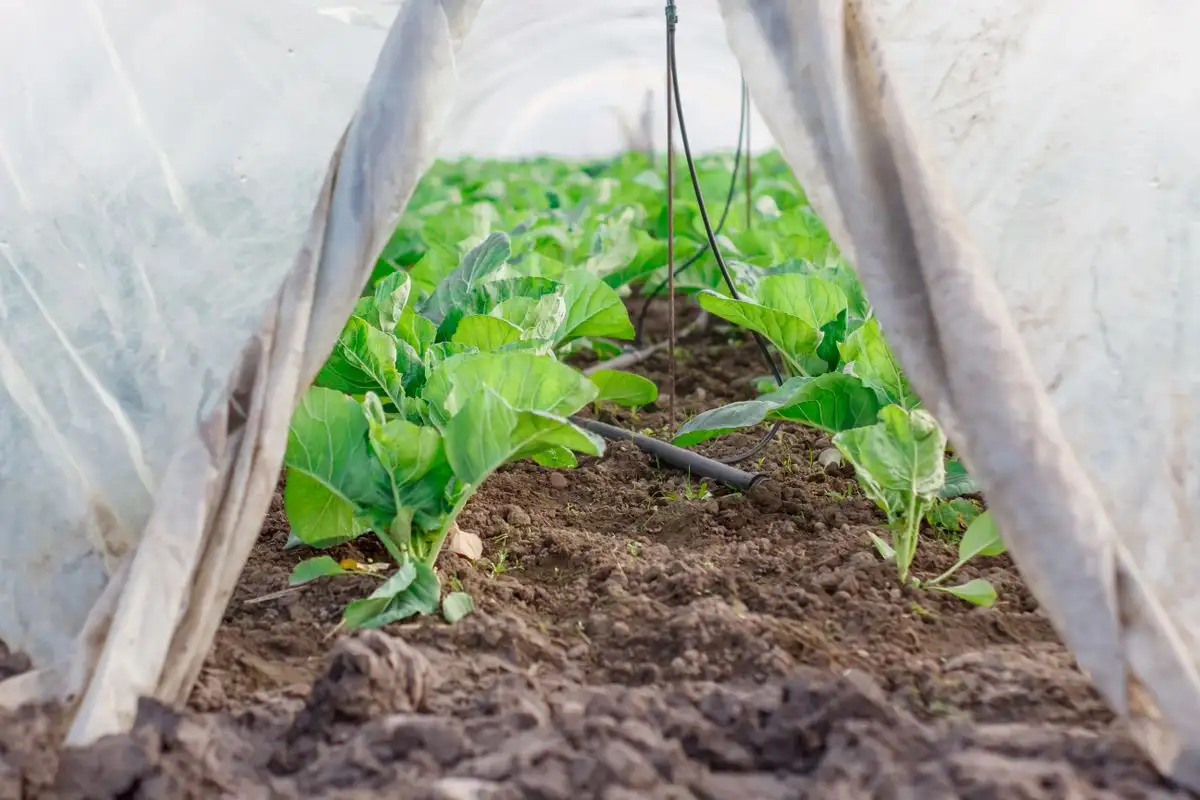
I keep a tape measure and a stub of pencil on the bed rail from late winter into spring, because that is the window where guessing gets expensive. Stand at the long side of the bed and hook the tape on the outside face of the rail. Outside, not inside. A bed sold as 4 by 8 feet is usually close to 4 feet across the outside of the wood, and the outside number is the one the hoop has to clear. Write it down. Then walk the length and write that down too, because tunnel length is a different number, and the difference between the two is where most of the wasted fabric goes.
Hoop width: the cover has to slope away from the leaves
The hoop is not sized to the bed. It is sized to the bed plus room for the cover to fall away at an angle instead of dropping straight down onto the plants. Twelve to 18 inches of extra span is the working range. On a 4-foot bed, that puts the hoop feet roughly 5 to 5.5 feet apart at the soil.
Why the slope matters: a cover that touches wet leaves in March moves cold straight into the tissue, and any leaf pressed against fabric stays wet longer. Slope also buys shoulder room. I would rather have a hoop that is a little wider than one that is a little taller, because you can always duck, and you cannot always un-crush a plant.
Where the hoops sit is its own decision. Pushed into the soil just inside the bed rail, they keep the cover over the bed but eat 3 or 4 inches of growing width on each side. Set outside the rail, the cover comes down outside the bed and you have to reach over it to water. I put them inside on narrow beds and outside on wide ones, and I have never regretted either. I have regretted the tunnel that was neither.
The row cover width almost everyone gets wrong
This is the mistake I made twice. The cover does not span the bed; it spans the arc. A hoop that is 5 feet wide at the ground and about 2.5 feet tall at the apex carries roughly 8 feet of fabric from ground to ground, because the fabric travels up one side, over the curve, and down the other. The arithmetic is close to pi times half the span, and it is why a 6-foot-wide roll looks generous in the store and comes up short in the garden.
Add 1 to 2 feet for the slack you need to weight or bury at the ground. For that 5-foot hoop, plan on a cover around 9 to 10 feet wide, not 5 or 6. Flatter hoops need less; a nearly flat tunnel is closer to bed width plus a bit. The taller and rounder the hoop, the more fabric disappears into the curve.
If you already own a roll that is too narrow, the tunnel is not useless. It just becomes a tunnel whose edges sit above the ground, which is fine on a mild night and close to worthless on a hard freeze. I ran one that way through one April and retired it the following November.
Interior height is set by the crop, not by the hoop
Measure from the soil surface, not from the top of the rail, and measure to the tallest point the plant will actually reach, not the height it is today. Then add 6 to 12 inches of air. That clearance is not really for the plant. It is for the cushion of still air between the leaves and the cover, and it is also what keeps the fabric off the growing tip when wind pushes the tunnel sideways.
Salad greens are the easy case. Lettuce, spinach, arugula, mache, claytonia: the whole harvest lives below about 12 inches, and a tunnel with 12 to 18 inches of interior height is plenty. You can go lower if you are cutting and coming again and do not mind the cover resting lightly on the outer leaves.
Brassicas want more room. Kale, broccoli, and Brussels sprouts run 24 to 36 inches by the time they are worth harvesting, and a fall tunnel over them needs 3 to 4 feet at the apex. If your hoops are cut to greens height, the kale will simply lift the cover off the ground in October, and you will spend the rest of the season re-burying edges.
Why tomatoes break the sizing rule
Determinate tomatoes top out around 3 to 4 feet. Indeterminate tomatoes do not top out at all. They will run 6, 7, 8 feet in a good season, and a low tunnel tall enough to clear them is no longer a low tunnel.
That is the honest limit of this structure. I do not try to carry indeterminate tomatoes under hoops for the season. I use a low tunnel over transplants to get them through the last frost and the first few weeks of cold nights, then pull the cover and let the plants go. By the time they reach the hoop, the tunnel has already done its job. If you want season-long protection over tall fruiting crops, you are shopping for a high tunnel or a cold frame, and the sizing math changes completely, because those are sized to a door and headroom rather than to a row cover arc.
Peppers are similar but less dramatic. They run 2 to 3 feet in a home bed, so they sit right at the edge of what a low tunnel handles. Give them a 4-foot interior height and you are fine. Give them 2 feet and you will be fighting the cover all summer.
Length and end access
Run the tunnel 1 to 2 feet past each end of the bed. Two reasons, and both of them show up on the same morning. The extra length gives you somewhere to gather and clip the cover at the end instead of dragging it across the plants. It also keeps the end wall from rubbing on whatever is growing in the last foot of the bed, which is usually the plant you care about most.
The opening at the end should be wide enough to get a watering can, a harvest basket, and your arm in without peeling the whole cover off. Something in the 18-to-24-inch range works for most home beds. Venting is the other half of that. On a bright day in February, a sealed tunnel can run far warmer inside than the air outside, and the fastest way to cook a crop is to leave it closed through a sunny afternoon. An end you can open in ten seconds is part of the size, not an accessory.
Hoop spacing is a load question, not a looks question
Spacing falls out of what the tunnel has to survive. A cover-only tunnel in a mild climate can run hoops every 3 feet and be fine. Anywhere snow sits on the tunnel, or where wind funnels between buildings, tighten to 18 to 24 inches and use a stiffer hoop. Cover weight matters too. Thicker, heavier fabric sags more between hoops and pulls the whole arc down as it warms in the sun.
The count is simple once spacing is picked: bed length plus the overhang at both ends, divided by spacing, plus one. Round up. Hoops are cheap next to the afternoon you spend redoing them.
Anchoring to the raised bed frame
Raised bed walls make a good anchor point, and using them saves you from fighting soil. Pipe straps or brackets screwed to the wood or metal frame hold a hoop leg more securely than pushing it into loose mix, and they keep the span consistent from hoop to hoop, which keeps cover tension even.
On a metal bed, plan on a clamp or a strap, because you are not driving anything through the rail. On wood, exterior screws or lag screws into the rail hold well, but check them at the end of the season, since a hoop that has been loaded with snow all winter works the fastener loose. Burying the hoop feet a few inches into the soil inside the bed also works and costs nothing, but the arcs wander, and a wandering arc means a cover that is tight in one place and slack in another.
Draw it before you buy
Top-down view: bed length and the overhang at each end. End view: hoop width at the ground, interior height at the apex, and the arc between them. From those, you get the hoop count and a cover width you can actually shop for. Five minutes with a pencil, and it is the difference between one trip to the store and three.
The last thing I would pass along is the thing I wish someone had told me earlier. A low tunnel is a shape, and the shape is set by the crop. Decide what is going under it first, then size the hoop to that plant. Everything else, the pipe, the fabric, the clips, is downstream of a tape measure and a seed packet.