
Seed that feels bone dry can still rot in a sealed jar because only two variables decide how long it keeps, and the jar protects neither one. Moisture content and temperature are the whole story. A bean at 10 percent moisture is stable in glass at room temperature. The same bean at 13 percent feels identical in your hand, but that extra water comes into equilibrium with the air around it and drives the humidity inside the jar into the sixties and above, which is where mold gets a foothold. Get both numbers right and the jar behaves like a time capsule. Miss one and it behaves like a slow incubator.
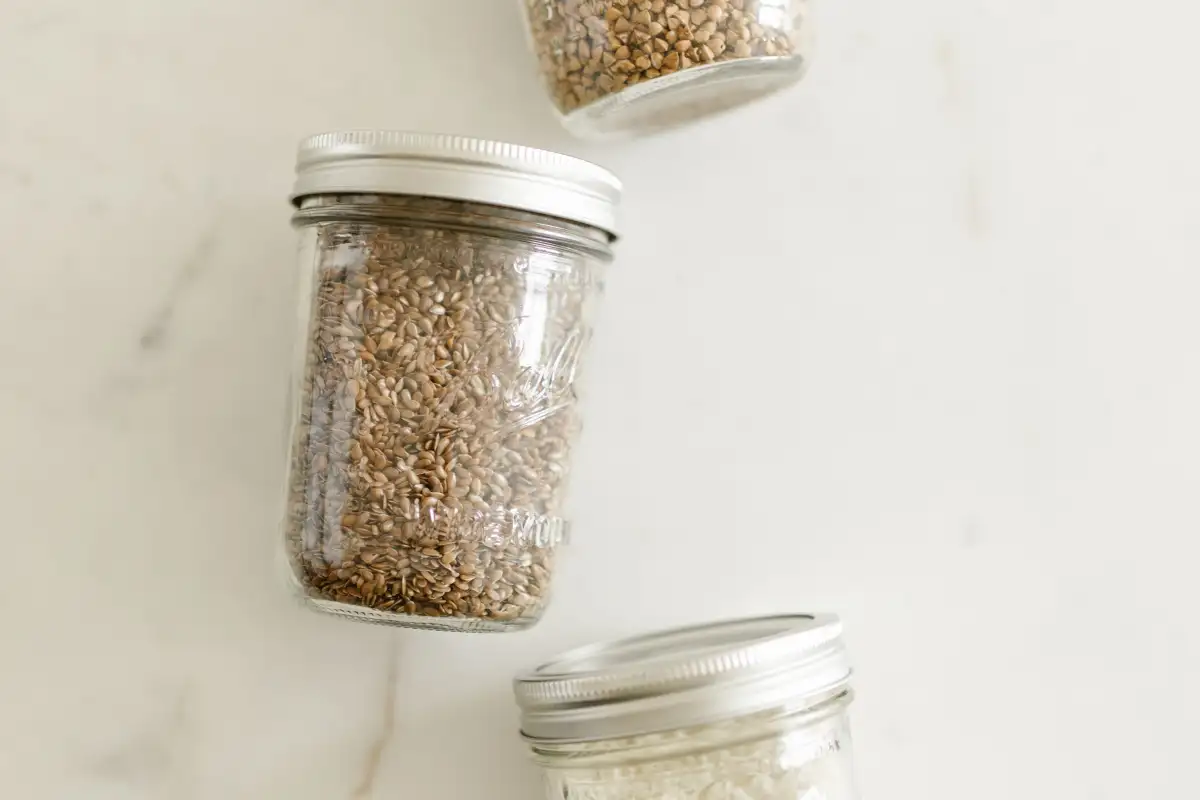
I found that out the annoying way, with a jar of cucumber seed. Cucumber is one of the forgiving ones, five years and more under decent conditions. Mine came up at about one in five the second spring, and there was no fuzz on it, no smell, nothing to look at. The seed just didn't have anything left to give. It had been in a sealed jar the whole time. It had been dry to the touch the whole time.
That took me a while to internalize. The jar isn't doing the work. You do the work before the jar, and the jar just holds the result. So when I read someone saying their seed rotted in storage, I'm usually already thinking about two numbers, and neither one of them is about the container.
What a sealed jar is actually doing in there
It's a closed system. Once the lid goes on, the seed and the air in the headspace trade moisture back and forth until they settle into equilibrium, and that equilibrium is set by how much water is in the seed and how warm the jar is. Nothing else gets a vote.
A seed at 8 to 10 percent moisture holds the air around it somewhere in the thirties, relative humidity. That's a desert. Nothing grows in it. A seed at 12 or 13 percent holds that same air at 60 percent and up, and mold, which was already sitting on the seed coat as spores, now has what it needs. It doesn't need the seed to be wet. It needs the air around the seed to be wet enough, and in a sealed jar the only water available to make that happen is the water already inside the seed.
That's the mechanism people miss. The jar doesn't let water in. It concentrates what's there. A paper envelope breathes, so a slightly under-dried seed can shed a little vapor and get away with it. Glass doesn't. The flaw gets sealed in with it.
The snap test, and why it isn't the finish line
Before anything goes in a jar, I bite it. A big seed, a bean or a pea or a corn kernel, pressed between my thumbnail and my index finger, or bitten if I trust where it came from. A dry one shatters. It makes a sound. A bean still holding water dents, or flakes, or leaves a mark on your thumbnail. For small seed I pinch a few and crush them: a lettuce or pepper seed at 8 percent turns to powder, a damp one smears.
Snap is the minimum, not the target. It's the point where seed is dry enough not to mold immediately. It isn't necessarily 8 percent, and the gap between snaps and stable-in-a-jar-for-five-years is exactly the gap I lost that cucumber seed in.
So after the snap I keep drying. A shallow tray, a screen, a fan moving air across it, out of direct sun, two days to two weeks depending on the weather and how big the seed is. Then I snap-test again.
And here's the part that took me years to accept: in a humid place you cannot finish drying in open air. Above about 50 percent relative humidity in the room, dry seed pulls water back out of the air instead of giving it up. On a 70 percent August day, a tray of seed on the counter equilibrates toward the room, not toward 8 percent, and it can finish wetter than it started. Drying is a weather-dependent operation. On those days I dry indoors, in air conditioning, or in front of a fan in the driest room in the house, and I still finish with a desiccant in the jar.
The desiccant is doing a job the lid can't
A packet of silica gel or a paper twist of powdered milk sitting in the jar pulls the headspace humidity down and holds it down. It's the difference between a jar that's stable at 10 percent moisture and a jar that's stable at 8 in a house that runs humid all summer.
Two things about desiccants I had to learn by wasting a season. First, they have a finite capacity. A saturated packet is a damp sponge sitting next to your seed, which is worse than nothing. Silica that has changed color comes out and goes into a warm oven to be dried back down. Powdered milk doesn't come back; it's one and done and should go in fresh. Second, the packet doesn't have to touch the seed. I keep it above the seed or taped under the lid, so if anything goes wrong it isn't in direct contact.
Temperature, and the cold jar trap
The old rule of thumb is that every 1 percent drop in seed moisture, or every 10 degrees Fahrenheit drop in storage temperature, roughly doubles how long the seed stays good. Two dials, same clock. That's why a jar in a 70-degree closet and a jar in a 40-degree fridge are not the same jar over five years, even with identical seed in them.
But cold carries a trap, and it's physics, not opinion.
Relative humidity is relative to temperature. Cool air holds less water before it's saturated, so the same amount of water vapor becomes a bigger fraction of what the air can hold. Seal a jar that's sitting at a comfortable 35 percent humidity on a shelf, then move it to the fridge. As the jar cools, the absolute amount of water in the headspace doesn't change, but the ceiling drops. That humidity climbs, possibly far enough to start condensing on the inside of the glass and on the seed. The cold slows the mold down, so you may not see damage right away, but the seed is reabsorbing the moisture you spent two weeks taking out of it.
This is why the rule is always fully dry, then cold, and never the other way around. It's also why a desiccant matters more in a fridge jar than in a shelf jar, not less. And it's why freezing, which is the best storage there is, is only for thoroughly dried seed. Freeze seed that's still carrying 12 or 13 percent moisture and you're building ice crystals inside living tissue.
There's a second half to the trap, and it's the one I still catch myself on: opening the jar. A cold jar carried into a warm kitchen sweats. Water beads on the glass, and it beads on the seed. Every time. Pull a jar out of the fridge and pop the lid to grab a pinch, and you have just rained on your seed.
So the jar comes out and sits, closed, until it's room temperature. A small jar, a couple of hours. A big one, overnight. Nobody told me that one. The glass told me.
Stability beats cold
Something almost nobody mentions: steady beats cool. A closet shelf that holds 72 degrees year round is a better home than a spot by a window that swings from 58 at night to 95 at midday in July. Those swings are what move moisture around inside the jar. The headspace warms, the ceiling rises, water leaves the seed. The headspace cools, the ceiling drops, water goes back, but never quite in the same place. Every cycle costs you a little. Vegetable seed isn't terribly sensitive to a constant warm room. It's sensitive to a jar that breathes.
Shelf life is not one number
Everything above sets the slope of the line. Where the line starts is different for every crop, and that trips people up as much as the storage does.
Onion and parsnip are the brutal ones. A year at room temperature and they're often done. Not moldy, not shriveled, just nonviable. I've watched onion seed go from a good germination rate to almost nothing inside a single winter. Parsnip behaves the same way and doesn't always give you a full year.
Cucumber, lettuce, melon, and most of the squash family sit at the other end. Five years is normal in a cool dry jar, and I've planted lettuce at seven that came up fine. Beans, peas, and the brassicas are in the middle, three to four years with decent handling.
The rules don't change. A jar of onion seed at perfect conditions is still a one-year product and should be treated like one. Sow it thick. Replace it every spring. Never trust it in year three.
The failure I actually see
Not mold. Not fuzz and not smell. The failure in my jars and in friends' jars is quieter: seed in a sealed container, in a humid house, at room temperature, most of the germination gone in about two years. The seed looks exactly right. It rattles. It snaps. It just comes up at 30 percent, and the grower blames the weather, or the variety, or the nursery.
Storage conditions are almost never the reason you want them to be.
The order I actually do this in
- Dry until a big seed shatters and a small one crushes to powder.
- Keep drying: screen, fan, air conditioning, whatever gets the room dry. Days, not hours.
- Snap-test again. And a third time, if the weather has been bad.
- Decide where it goes. Shelf, fridge, or freezer. Fully dry is the entry fee for cold, no exceptions.
- Desiccant in the jar if your climate runs humid. Silica if you'll bother recharging it, milk powder if you'd rather just pitch it.
- Glass with a rubber gasket, or a freezer bag doubled inside a second freezer bag. Not paper. Not a single ziplock past one season.
- Label crop and year. You will not remember.
- Come back to room temperature before opening. Every time, no matter how quick you think you're being.
Two dials. Moisture and temperature. The jar is just what you put around them.