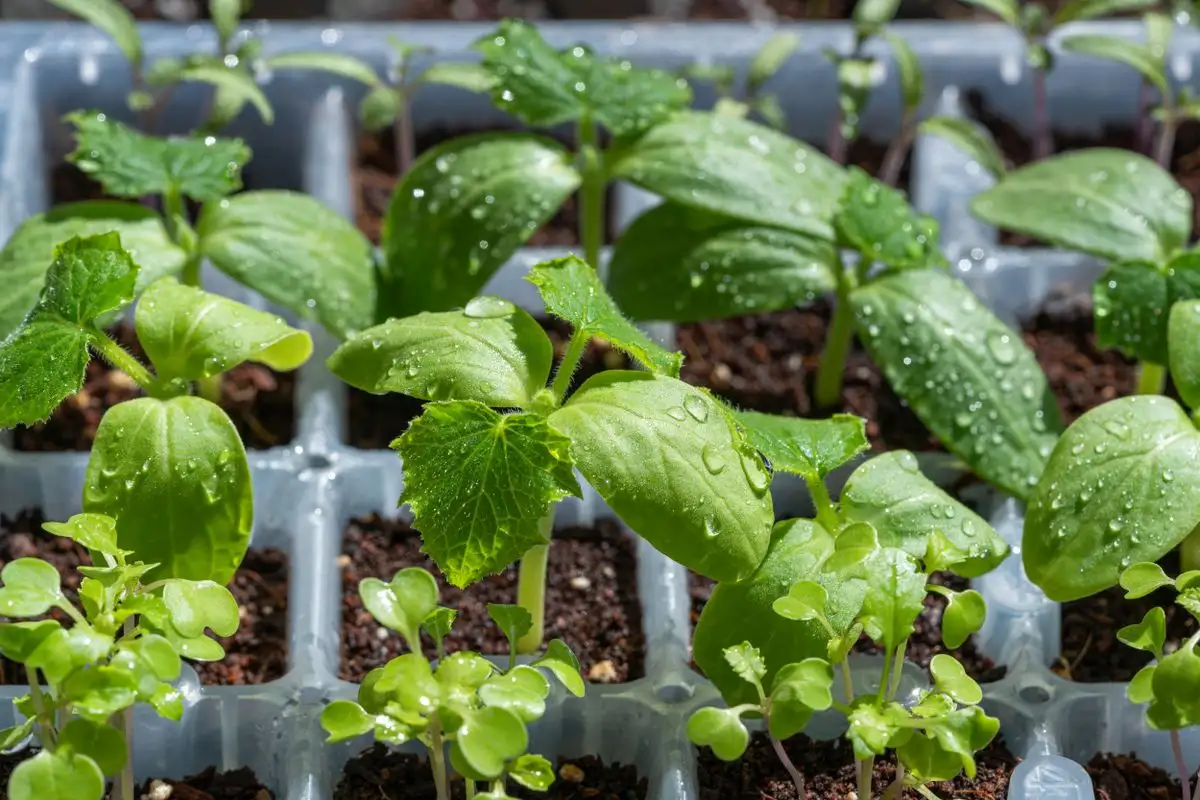
You can keep harvesting after frost on a small balcony, and the answer is not a greenhouse. Season extension in containers is four adjustable levers — frost-date math, cold protection, succession timing, and crop choice — and in a small space the two free ones, timing and crop choice, buy more weeks than the hardware does. A greenhouse kit is the most expensive lever and, unheated and unventilated on a windy balcony, usually the weakest.
Come out here with me. It is a little before ten on a night in late October. The forecast says 30 degrees. I am six floors up, standing on cold concrete, with eight mismatched pots of spinach, kale, and carrots grouped against the building wall, and a cheap min/max thermometer lying on the soil in the middle pot. It is the kind with a little pin that gets pushed down by the coldest moment of the night and stays there. That pin is the entire point of the next ten minutes. The row cover over the spinach is flapping against the railing, and I can hear it. I kneel down and read the pin, and it says 28. The forecast said 30. Two degrees and six floors is not a rounding error. That is the difference between spinach that shrugs and spinach that turns to slime by morning.
That is the moment season extension on a balcony stops being about buying something and starts being about arithmetic.
Frost dates are two different numbers, and your railing is a third
USDA hardiness zones describe average annual minimum winter temperature. That is a survival number. It tells you what can live through a winter where you are, not when to sow anything. Vegetable timing runs on average first and last frost dates, which come from NOAA climate records compiled by your land-grant extension for your area. Those are different numbers answering different questions, and if you use your zone as a planting calendar you will be off by weeks.
Then there is the third number, which is yours alone. My neighborhood has an average first fall frost in mid-October. My balcony does not. It faces the wrong way, it sits under an overhang, and it is high enough that wind moves through it in a way it never does at ground level. A balcony a mile from mine, tucked against a south-facing brick wall, holds two or three weeks longer on the same night. Same zone, same city, different answer.
So here is what I do. I look up the extension frost table for my area, take the 50 percent date as the middle of the range rather than the edge, and plant to be finished two weeks before it. Then I walk my own balcony on cold nights with the thermometer and build the real number from that, because the published date is a starting point and nothing more.
The cheapest lever is a calendar
Build backward. Take a crop's days to maturity off the packet. Now add a buffer, because those ratings assume long, bright, warm days, and September and October are neither. In shortening light, a 45-day spinach can take 55 or 60 days. Nothing dramatic has to happen for a fall crop to miss. It just grows slower, and then the frost arrives while it is still filling out.
Average first fall frost, minus your buffer, minus days to maturity, equals your sowing window. If that math puts you in early August for something you wanted to eat in November, the answer is not more plastic. The answer is a different crop or an earlier sowing next year. That lever costs nothing and it is the one most balcony growers never pull.
Crop choice works the same way. Cool-season vegetables — spinach, kale, lettuce, arugula, chard, radishes, carrots, beets, broccoli, cabbage, peas — tolerate light frost, commonly somewhere in the 28 to 32 degree range depending on the specific crop. Tender crops such as tomatoes, basil, peppers, cucumbers, beans, and squash are damaged at or near freezing no matter what you drape over them. And a handful of cool-season crops actually improve after a frost: carrots, parsnips, kale, and collards convert stored starch to sugar as temperatures drop, which is why a December carrot tastes sweeter than an October one. That comes from extension guidance, not from my opinion.
Which leads to the honest rule. You are not extending tomatoes into November on a balcony. You are switching the plot over to crops that do not need extending, and then using the levers to push those further than they would go on their own.
Then the plastic, and what it will not do
Row cover is the next lever, and it is smaller than people expect. A single layer of floating row cover raises the nighttime air temperature around the plants by only a few degrees. Its bigger contribution is that it blocks wind and holds the warmth already in the soil.
That distinction matters far more in a container than in a bed.
Pots lose heat on all four sides
A raised bed has the ground underneath it. A pot has air. Roots in a container are exposed to cold on the sides and the bottom as well as from above, so the same crop that sails through 28 degrees in garden soil can be killed at 32 in a five-gallon pot. There is no ground heat to borrow, so you have to manufacture whatever buffer you can.
What actually helps, roughly in order of return:
- Group the pots together. Shared air, less exposed surface.
- Push the cluster against the building wall. Masonry gives back some of what it absorbed during the day.
- Get the pots off the concrete. Cold slab pulls heat out of the bottom of a container all night long.
- Mulch the soil surface.
- Fill a couple of jugs with water, let them sit in the sun, and set them among the pots. They release heat after dark.
- Only then drape the row cover over the whole cluster rather than over each pot, and weight the edges so it does not sail away at two in the morning.
That is the cheap version, and on a sheltered balcony it is usually enough to keep spinach, kale, mache, and carrots going well past the first frost date, often into December. Not because the cover is warm, but because the cluster plus the wall plus the mulch is holding what heat there is.
A greenhouse kit, on the other hand, is a windbreak with a price tag until you actually run it. An unheated plastic box in the sun gets hot by mid-afternoon, hot enough to cook spinach, and then has nothing to give back after dark unless there is mass inside it. Without ventilation it swings. Without thermal mass it drops to ambient. I am not saying never. I am saying it is the last lever to pull on a balcony, not the first, and if you are not going to vent it daily it will cost you more than it returns.
Under cover, everything else changes
Once something is draped, the rules shift, and this is the part that catches people in the second week.
Watering slows down. Cover cuts evaporation and blocks rain, so a pot that wanted water every other day in September might stretch to four or five days in November. Check by lifting the pot for weight and by sticking a finger in the soil. Not by the calendar.
Air movement drops to almost nothing. A covered, wet, unventilated pot is a mold farm, and seedlings under it will damp off. Lift the cover on mild days. Fabric lets light and some air through, which is one reason it beats solid plastic for most balcony use. A sheet of clear plastic over wet soil is the worst of both worlds.
And the cold-hardy slugs do not care about any of this. They will work under the cover all winter. Go out after dark with a flashlight once or twice a week and pick them off the stems.
Let the thermometer decide
The last piece is cheap, and it is the one that turns this from guessing into adjusting. Leave a min/max thermometer in with the pots. Not a weather app. A physical one, sitting at plant height, inside the cluster.
Now you get a real number every morning. If the forecast says 31 and your low reads 26, the cover is not doing what you thought it was, and you add mulch or a jug or move the cluster closer to the wall. If the forecast says 30 and your low reads 34, your setup is holding and there is nothing else to buy. That forecast is for an airport several miles away, with different wind exposure and no concrete around it. Your railing is its own weather.
I will state the limitation plainly. This gets you weeks, not a second summer. On a balcony with no ground heat to borrow, you are playing defense on a small budget. What you get is spinach in December, carrots you can pull through mulch in January, and cover enough to sow again in late winter while everyone else is still waiting for the ground to thaw. Tomatoes in January are not on the menu here, and anything promising otherwise is not describing a balcony.
Four levers, and only one of them costs more than a bag of mulch. Pull the free ones first.