The number of sowings one bed can carry into fall is arithmetic, not instinct. Take your average first fall frost date, subtract the crop's days to maturity, subtract another week as a buffer for the shorter, weaker light of late season, and you have your last sowing date. Divide the span between your first fall sowing and that date by the interval — 10 to 14 days for lettuce, spinach, radishes, and bush beans, 21 to 30 for carrots and sweet corn — and the answer is the number of rounds. On a four-by-eight bed, that usually lands between four and six.
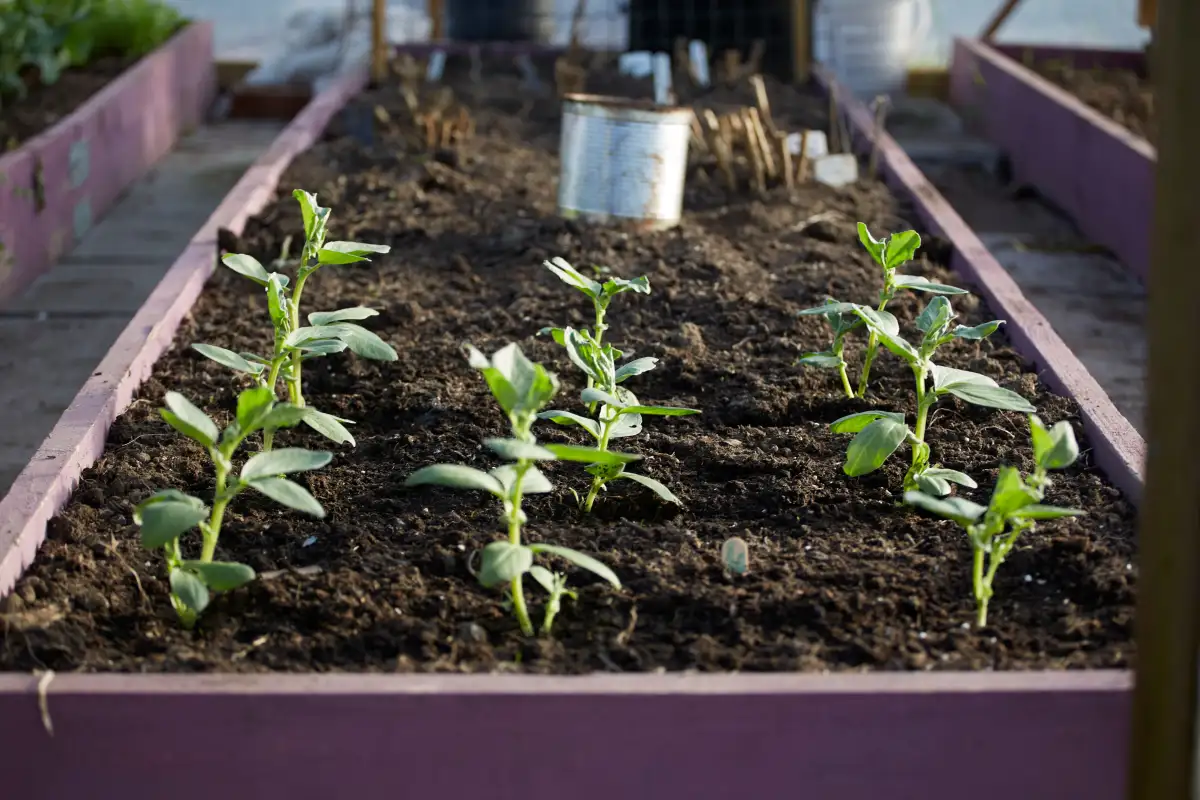
I do that math in the back of a spiral notebook before my hand goes anywhere near a seed packet. Late July, the peas are down and the first half of the bed is bare, and I'm standing at the fence rail with the notebook open on the top board and a pencil behind my ear, working out what goes in next. It takes four minutes. It saves me the ragged two weeks of October I used to get every year, when everything came ready in the same eight days and then nothing did.
Count backward, not forward
Say your average first frost lands around October 15.
Lettuce at 50 days from sowing: October 15 minus 50 days is about August 26. Take off a week of buffer, because a lettuce sown in August does not grow at June speed, and your last practical sowing is around August 19.
Now the front end. If the spring lettuce came out of the bed in mid-July, your first fall sowing is July 15. From July 15 to August 19 is 35 days. At a 10-day interval that's four sowings: July 15, July 25, August 4, August 14. At 14 days it's three.
Compare that to the same crop in spring. Same bed, same packet, but you're counting forward from your last frost date and stopping when the heat arrives. Different number entirely. That's the whole reason the fall count has to be done on its own, in its own column, with its own frost date.
What earns a second sowing, and what doesn't
Lettuce, spinach, arugula, radishes, bush beans, turnips, beets, cilantro. Anything that matures fast, that you eat in a single pass rather than picking off one plant for months, and that goes to seed or turns woody if you leave it standing.
Radishes are the cleanest case at 25 to 30 days. Put in a round, pull it, put in another round in the same square foot, and the soil never really rests.
Then there's the other list, and this is where I watch people burn seed. Tomatoes, peppers, eggplant, winter squash. You plant those once. A tomato set out in May keeps producing until frost takes it whether you sowed one or three. Succession-sowing a tomato gets you three plants fruiting at the same time, not a longer tomato season. Pole beans and zucchini have the same shape — they're built to be picked over a long window, so re-sowing them interrupts a harvest you already had.
Kale and chard sit in a third spot. You can succession-sow them. You just usually don't need to, because cutting the outer leaves every week does the job the calendar would have done.
The mid-summer round is a soil temperature problem
The July and early-August sowings are the ones that fail, and it is almost never the seed's fault. Lettuce seed goes thermodormant in warm soil — somewhere in the low 80s, germination drops off a cliff. Spinach is worse and barely worth attempting before late August.
What works here: shade cloth over hoops for the first ten days of a mid-summer round, 30 to 40 percent shade, and watering in the evening rather than at noon. Sow a little shallower than you would in spring, since you're going to be watering daily anyway. Or choose a slow-bolt type — summer crisp and bolt-resistant romaine types hold much longer in heat than a standard butterhead.
And sometimes the honest answer is to skip a round. If I can't hold the soil under 80 degrees for a week, sowing on schedule just plants a dead row. I'd rather drop that round and pick the interval back up in mid-August, when the nights start cooling, than pretend the calendar is the boss of the bed.
The log is the part that actually prevents gaps
Every gap I've had between batches came from remembering the last sowing wrong. Not bad seed, not weather — from thinking I'd sown "about a week ago" when it was eleven days.
So the log is three columns and a fourth. Date. Crop and variety. Expected harvest window. Then what actually happened. The expected column is the one that catches problems: run your eye down it, and if there's a stretch with nothing in it, that's where your gap will open, and you can still fix it.
The actual column is the one people skip, and it's the valuable one. Your beds run faster or slower than the packet's number, and after two seasons you know your own offset. My August lettuce takes roughly 12 days longer than the packet claims. That isn't a mistake on the packet. That's my garden, and it belongs in the buffer instead of in a general rule.
Empty space, used twice
A 25-day radish sown down the middle of a row of 70-day carrots costs nothing, because the radishes are out before the carrots need the room. Same trick with spinach tucked between brassica transplants, or arugula along the edges of a bed where the tomatoes won't sprawl for another month.
This is worth more than it sounds. In a small plot the real constraint isn't seed or soil or effort — it's square feet per week. An interplanted fast crop is a fifth round you never had to schedule.
Containers change the shape, not the math
The intervals still apply. What changes is the unit. A head of lettuce in a pot is a single harvest, gone in one cutting, so "one round" means one pot rather than one row. Two pots staggered ten days apart give you salad continuously. One pot gives you a salad on Tuesday and a bare pot after.
Because containers warm faster than ground beds, mid-summer germination is harder in them, not easier. A light-colored pot, mulch over the soil surface, and shade during the hottest hours do more for a July sowing than anything you do to the seed itself.
When the math breaks
Three things break it, and all three are worth watching for.
An early frost. The average is an average, and an October 15 average means half your years freeze before that date. I keep the last round of a fast crop — radishes, arugula — as the one I can afford to lose, and I don't put a 70-day carrot anywhere near the final slot.
Days to maturity counts from different places. On a lettuce packet it's usually from sowing. On a tomato packet it's from transplant. Use the transplant number for a direct-sown crop and your last sowing date comes out wrong in the safe direction, which only means you stopped sowing a week or two earlier than you had to.
Disease ends the season for some crops before cold does. Winter squash and cucumbers can come down with powdery mildew in September and quit producing while the weather is still perfectly fine. No amount of scheduling gets around a plant that's finished. That's one more argument for spending the succession budget on the crops that stay healthy to the end — the greens, the roots, the bush beans.
Do the count once, write the four or five dates on a page in the shed, and check the page instead of your memory. The bed does the rest.