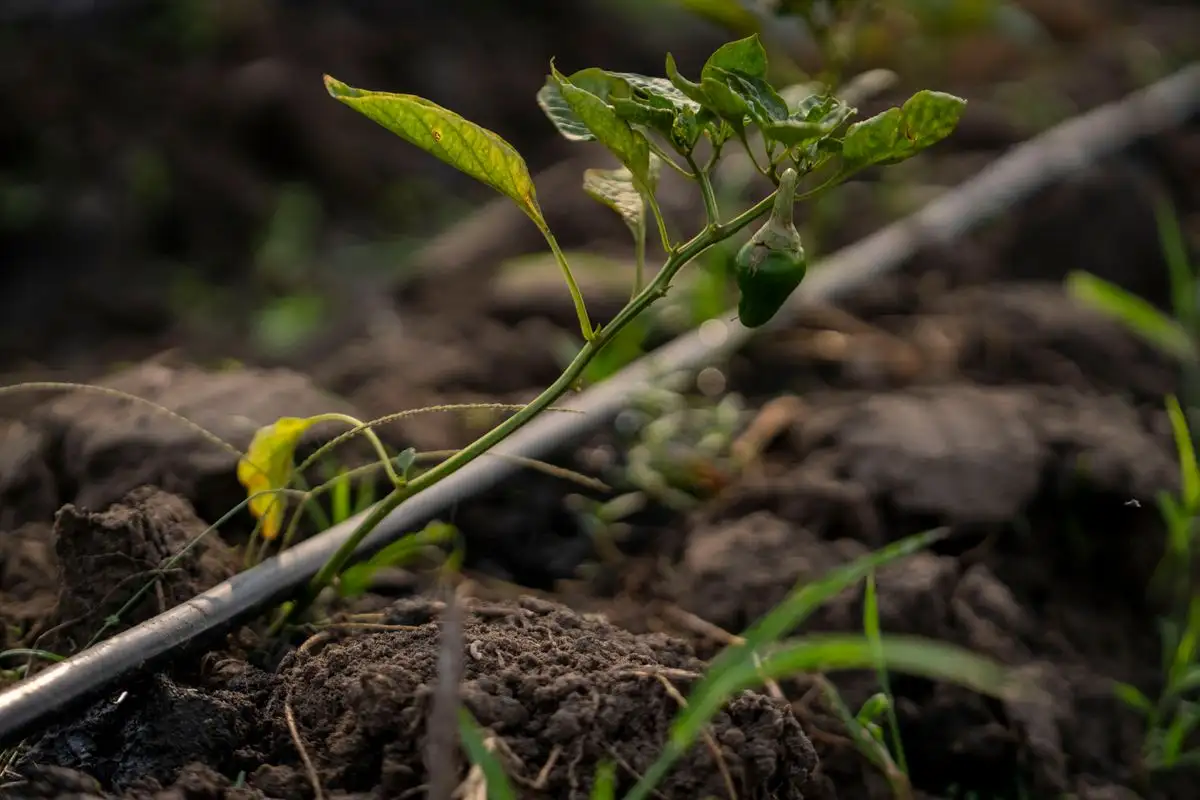
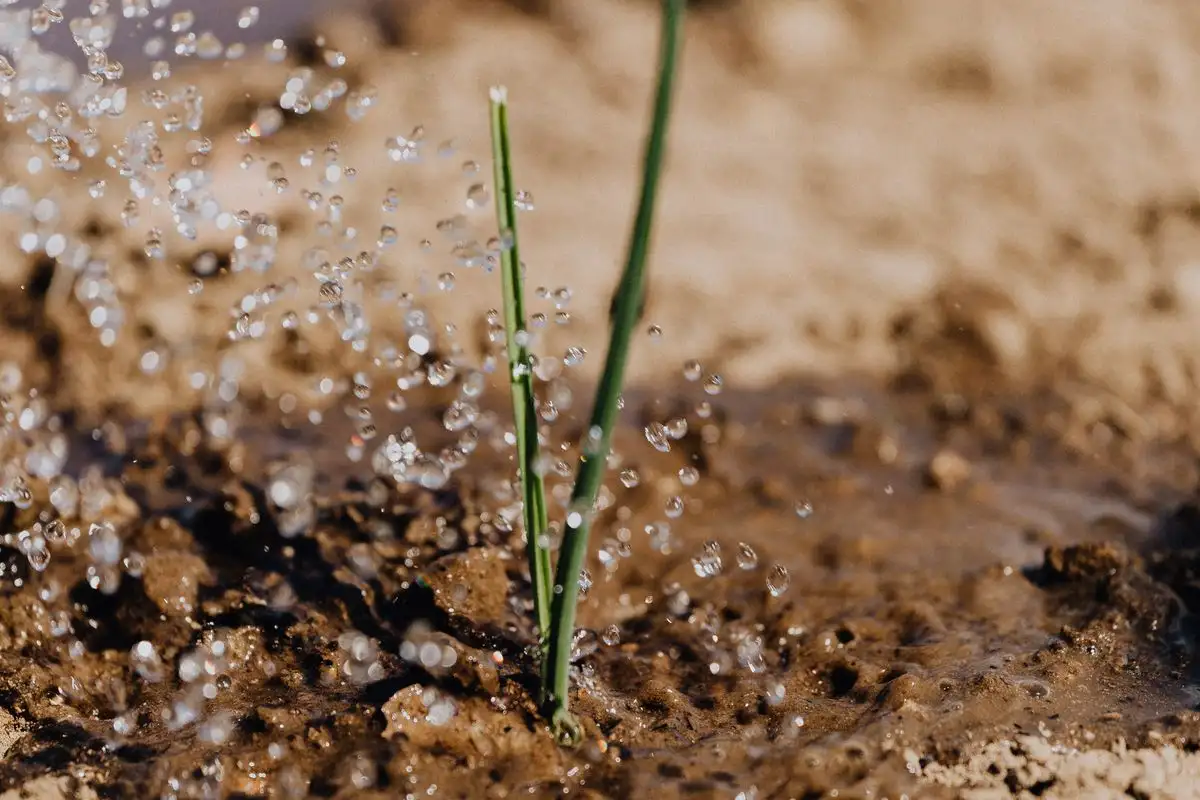
Fertilizer can travel through a drip line, but the order of operations decides whether it works: a short clean-water run to wet the soil, the fertilizer injected dilute, then a clean-water flush long enough to push the solution past the farthest emitter. That last flush does more for the line than the choice of fertilizer does. Leave it out and the residue either sits in the tubing feeding the slime that narrows an emitter, or it concentrates in the small wetted pocket under each emitter and burns the roots sitting in it.

I start at the end of the line, not at the bucket. The end cap comes off, the system runs clear water, and I hold a quart jar under the emitter farthest from the valve. On my balcony that's the one out at the rail, and it's the first to go soft on me. If it fills the jar at the same rate as the emitter near the valve, the line is sound. If it dribbles, something has already started to plug, and pushing fertilizer through a half-plugged line only makes the plug worse.
Then, when I'm working with a fertilizer I haven't run through the line before, I dissolve a scoop in a quart of water and leave it on the counter for twenty minutes. Grit at the bottom, a film on top, or a cloudy swirl that never clears means it doesn't go in the tank. That jar test is the whole rule, really.
What Will Actually Pass an Emitter
A drip emitter is not a hose. Under the cap there's a labyrinth channel measured in hundredths of an inch, and on a pressure-compensating emitter the whole point is that the channel flexes to hold a steady flow, which means anything abrasive or anything that swells gets pinned in place. The filter in front of it is typically a 200-mesh screen, an opening of about three thousandths of an inch, and that's the first place trouble shows up.
So the list of what goes through is short. Fully soluble salts, the kind that disappear in water and leave nothing behind. What doesn't: granular blends, slow-release prills, bone meal, blood meal, kelp meal, compost tea, anything with a particle you can see. Most of those won't make it past the screen either, which is why a filter packed with sludge feels exactly like low water pressure. I've watched people replace emitters that were fine when the real problem was a screen they hadn't opened in two months.
The Order I Run It In
Wet, inject, flush. Three steps, and each one has a job.
The pre-run isn't just warming up the line. Dry potting mix grabs the first flush of fertilizer and holds it near the surface, right where salts can pull water away from young roots before they're established. Running clear water first wets the profile so the fertilizer moves in solution instead of adsorbing onto dry particles. Ten minutes is usually enough for me to see water coming out of the far emitters and to feel the top inch of the pot go damp.
The injection is where the sequence is easiest to get wrong, and the mistake is almost always concentration, which I'll get to below.
The flush is the step I'd defend in an argument. How long depends on run length and emitter count, but the target isn't guesswork: push enough clean water through to displace the solution that's still in the tubing and carry it out past the emitters and into the root zone. In my setup that means a flush at least as long as the injection ran, sometimes twice as long on the pots at the far end.
The Flush Is Doing More Work Than You Think
There's always a thin film of water on the inside wall of drip tubing, even between cycles, and in summer that film is warm and dark. Add fertilizer to it and you've built a culture medium. Algae and bacterial slime grow in the line, and they grow fastest at the emitter, because the labyrinth is a narrow, slow, sheltered spot with a steady supply of nutrients. That's the mechanism behind most of the "mystery" emitter plugging people blame on hard water.
You can see it. Cut a two-foot section out of a line that's been fertigated all season without a flush and look at the inside. It's a brown slick that wipes off on your finger, and it's the thing narrowing your emitter. A proper flush prevents it by never leaving food sitting in the tube.
Which is also why cleaning products only get you so far. An overnight soak in white vinegar dissolves the mineral scale that builds up on emitters in hard water, and it's worth doing at the end of the season. It does almost nothing to biofilm. Different problem, different fix, and the fix for biofilm is the flush you either ran or didn't.
Concentrates That Fight Each Other
Calcium and phosphate don't get along when they're concentrated. Mix calcium nitrate with a phosphate fertilizer in the same stock tank and you'll get a milky cloud that settles into white crust on the bottom. Calcium with sulfate does a slower version of the same thing. The reaction happens in the stock tank, where everything is concentrated, not so much at the dilution that reaches the emitter. That's why a single blended product that's already balanced gives you no trouble, while a homemade two-part mix can wreck an afternoon.
The practical version: calcium in one tank, phosphate and sulfate in the other, injected at separate points in the cycle, and never the two concentrates in the same bucket. If you're reusing a tank, clean it first. A quarter inch of crust left in the bottom will dissolve slowly into the next mix and head straight for your emitters.
Worth knowing if your water is hard: it already carries calcium. Pair that with a phosphate-heavy feed and scale forms quietly inside the tubing over a season, which shows up as emitters that flow fine in May and dribble by August.
Why the Same Dose Hits Harder Through Drip
Hand watering spreads a given amount of salt across the whole surface of the pot, and the excess drains out the bottom. A drip emitter wets a bulb maybe a few inches across. Same salt, a fraction of the volume, and the concentration in that wetted pocket climbs fast. The root tips at the edge of the bulb are the ones that get hurt, and you won't see it happen. What you see, a week or two later, is scorched leaf margins and a plant that wilts in the afternoon even though the media is damp.
That's the reason fertigation through drip is done weaker and more often than hand-feeding, not stronger and less often. You're trading the convenience of one big dose for the requirement that you show up regularly with a small one. If that doesn't fit your week, the drip line is still a fine way to water and the fertilizer can stay in your watering can.
Backflow, which isn't optional
If a fertilizer injector is connected to household water, it needs backflow prevention. The injector can push solution backward into the plumbing on a pressure drop, and no garden is worth a tank of fertilizer in the kitchen tap. A hose bibb vacuum breaker is the minimum, and if you're on a well or a shared system, check what your local code asks for, because it may want more than the minimum.
Timing Is a Soil Test and a Growth Stage, Not a Calendar
Over-application is so easy through a drip line because nothing announces it. No runoff across the patio, no splash, no puddle. The salts go into the root zone and stay there.
So I run my feed off two things: a soil test, and what the plant is actually doing. The soil test tells me what's already there and what isn't, which is the only way to know whether I'm feeding a deficit or just adding to a surplus. The plant tells me the stage. Young transplants and plants in active vegetative growth take a steady supply; a crop that's finishing up doesn't need more, and pushing it just leaves residual salt in the pot for the next thing I plant.
What I don't do is feed on a fixed every-other-Tuesday schedule. The calendar doesn't know whether the pots got rained on for a week, or whether I've already pushed a flush through, or whether the plants are two weeks behind because of a cold spring.
The choice of fertilizer matters less than the sequence you run it in. I've had a season where the fertilizer was whatever was on the shelf and the line stayed clean, and a season where the fertilizer was exactly right and half the far emitters plugged by August. The difference both times was whether the flush actually happened. At the end of the season I pull one emitter, soak it in vinegar overnight, and check whether it flows even again. If I skipped a flush in July, I already know what I'll find.