Match the method to the weed's growth stage and to the vegetable's root zone, not to whichever tool is closest to the shed door. Young annual weeds in moist soil come out fastest by hand. A sharp hoe worked shallowly on a hot, dry afternoon kills more weeds per minute than pulling ever will, because a severed top dries out instead of re-rooting. Flame weeding earns its place on tiny broadleaf seedlings and almost nowhere else. Cultivating between rows has to stay barely an inch deep, or it prunes vegetable roots and drags a new generation of weed seed to the surface. And whatever you choose, it has to be repeated every seven to fourteen days while weeds are emerging hard.
The stage matters more than the tool
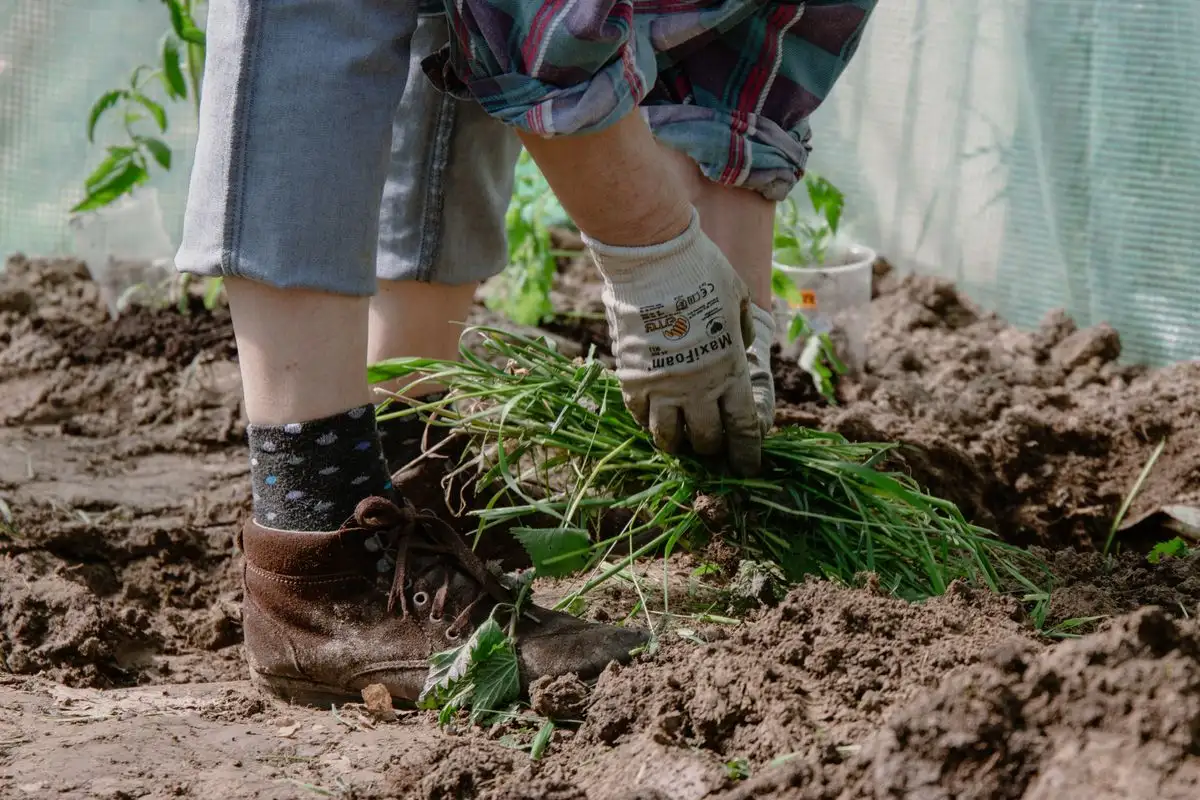
On my knees in the third week of June, in the strip between the tomatoes and the basil, holding a hoe I had no business swinging. The pigweed was maybe two inches tall. I could have pinched the whole row out with two fingers in less time than it took to stand up and line up the blade.
That's the part that gets left out of most weed advice. In a small plot you don't pick a method because you like it. You pick it because of three things: how big the weed is, what the soil surface is doing that day, and how far the vegetable's roots run under your blade. Get those three in the right order and weeding stops being a war you're slowly losing.
Before anything else, learn to read the weed with your fingers. Pinch it low and pull slowly. If it slides out with a little pop and a thread of fine root, it's an annual, and the top half of the plant is the whole plant. If it hangs on, resists, and comes up with a white or tan cord attached, stop. That cord is a rhizome, and yanking it hard breaks it into pieces, each of which becomes a new plant. Bindweed and quackgrass taught me that the expensive way — one summer of pulling that turned six feet of bed into a solid mat.
So the first decision isn't hoe versus hand. It's annual versus perennial. Everything else follows from there.
Hand pulling: what it's actually good for
Hand pulling is the least damaging method you have, and that's its real value, not its speed. Fingers don't shear roots, don't lift a slice of soil, and don't turn over the buried seed bank. On a bed of carrots or a tight row of beets, that matters more than finishing fast.
Timing matters twice over. Pull within a day or two of rain or a good watering, when the soil is moist but not soupy. A small annual weed in that condition comes out with its root intact. The same weed in dry soil snaps off at the crown and grows back from the stump within a week.
And there's a rule I use on myself: if it's under two inches, pull it. If it's over four inches and it's an annual, pull it anyway but expect to come back — and if it has flowers or seed heads, get it out of the garden entirely. Do not shake the soil off it back onto the bed. That shaking is the whole reason you were weeding in the first place.
Perennials are where hand pulling goes wrong. Nutsedge, bindweed, and quackgrass regrow from fragments. For those, you either dig the entire underground structure out with a fork, or you don't pull at all — you cut them at the soil line every week or so until the root system starves. Pulled rhizomes go in the trash, not the compost pile. I keep a separate bucket for that, and it's the only bucket I empty into the garbage can.
Hoeing is a timing tool, not a muscle tool
Here's the picture: a dry, bright morning in July, sun already high, soil surface pale and crumbly. You walk backward down the path, dragging the blade just under the surface, and the little weeds flop over onto the dry ground behind you. By early afternoon they're brittle and done. That's hoeing working the way it's supposed to.
Now the same hoe on wet soil under a cloudy sky. Same effort, same sweat, and half those severed weeds re-root by the weekend, because a chopped stem lying in damp soil will often push new roots. Wet ground doesn't crumble either — the blade smears it, and you end up with a crust that sheds water instead of absorbing it.
So the rule isn't "hoe." It's "hoe on a hot, dry, sunny day, and only when the weeds are small." The blade skims, cutting just below the crown. You're not chopping. You're slicing.
What shallow actually means
About an inch. Maybe an inch and a half on ground you've worked for years. Vegetable feeder roots live in the top few inches of soil — tomatoes, peppers, and squash especially have roots running wide and shallow right under the surface where you can't see them. Every deep hoe pass cuts some of them, and the plant pays for it in water stress for days afterward, which looks a lot like a disease problem until you remember what you did on Saturday.
And there's a second cost. Weed seed sits concentrated in the top inch or so of soil. Dig deeper and you turn up a fresh cohort you didn't know you had. This is why a gardener who hoes deep every week seems to have more weeds, not fewer. They're farming them.
If you're working close to a row, use the corner of the blade, hold it nearly flat, and steer with your back hand. Or put the hoe down and use your fingers. There's no prize for finishing with the tool.
Flame only does one job
A flame weeder doesn't burn weeds. It heats them for a second or two, the water inside the cells expands and ruptures the cell walls, and the plant wilts and dies — usually within the hour on a warm day. The leaves often don't look scorched at all, just limp. So if you're standing there waiting for blackened foliage, you're overdoing it and wasting propane.
That mechanism tells you exactly what the tool is good for. Tiny broadleaf seedlings with tender, exposed growing points. Not grasses — their growing points sit low and protected, and they regrow from the base. Not established perennials, which shrug it off. Not anything with a woody stem.
The classic use is the stale seedbed and the slow-sprouting crop. You prepare the bed, water it, let the first flush of weed seed germinate, and flame the whole surface before you plant. In a carrot row, where the crop takes forever to come up, you can mark a few seeds in a clear corner, wait for those to germinate, and flame the bed the day before the carrots break the surface. You get carrots in a clean row instead of carrots in a lawn.
There's a limit worth naming out loud. Flame near dry mulch, straw, or anything plastic and you have a fire, not a weed strategy. Keep water within reach. Don't use it in wind. And check the bed a week later, because flaming the top flush doesn't touch the seed still sitting below it.
Between the rows: waking the seed bank
Cultivating — the three-tined hand cultivator, the scuffle hoe, the wheel hoe — is for the paths and the wide gaps between rows, not for the strip at the base of the plants. Keep it an inch deep, keep it dry, and keep it away from the crowns.
Every pass lifts soil. Lifting soil means light reaches seeds that were buried too deep to germinate, and light is what starts them. If you cultivate on a schedule regardless of whether weeds are up, you're essentially running a germination program on your own dime. Scrape only where you see green.
In a small garden, mulch does more of this job than cultivation does. Once transplants are up and the soil has warmed, an inch or two of straw or finished compost on the paths and between rows knocks out the light and cuts germination hard. It doesn't eliminate the problem. It just means your cultivation passes are for the escapees instead of for the whole population.
Repeating beats perfecting
None of this works as a one-time event. During peak emergence — late spring into early summer, when soil is warm and moisture is steady — a new flush shows up every seven to fourteen days. Miss one, and those weeds set seed, and you've just paid for next year's crop of them.
So I don't think of it as weeding. I think of it as a ten-minute walk with a hoe or a bucket every week, taking out anything under two inches. Small, shallow, dry, and often beats big, deep, and thorough every single time. The weeds you kill before they're an inch tall cost you almost nothing. The ones you kill at a foot cost you a summer.