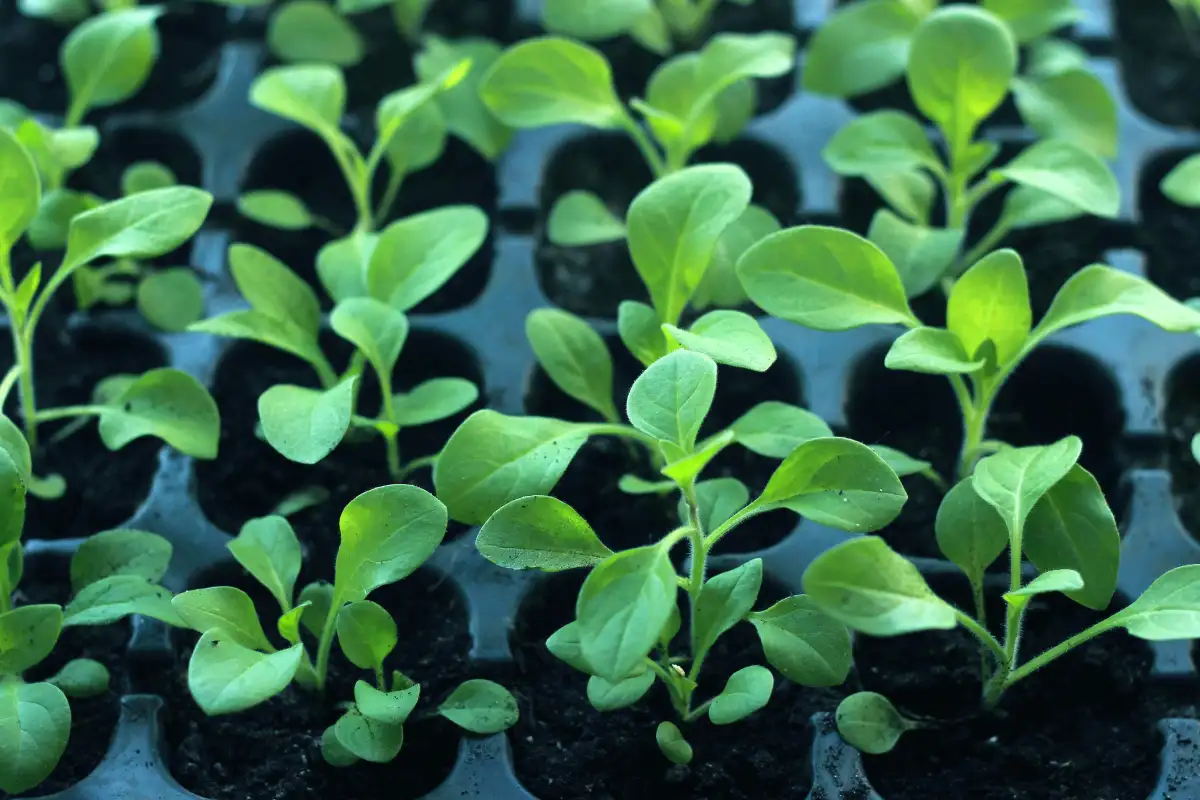
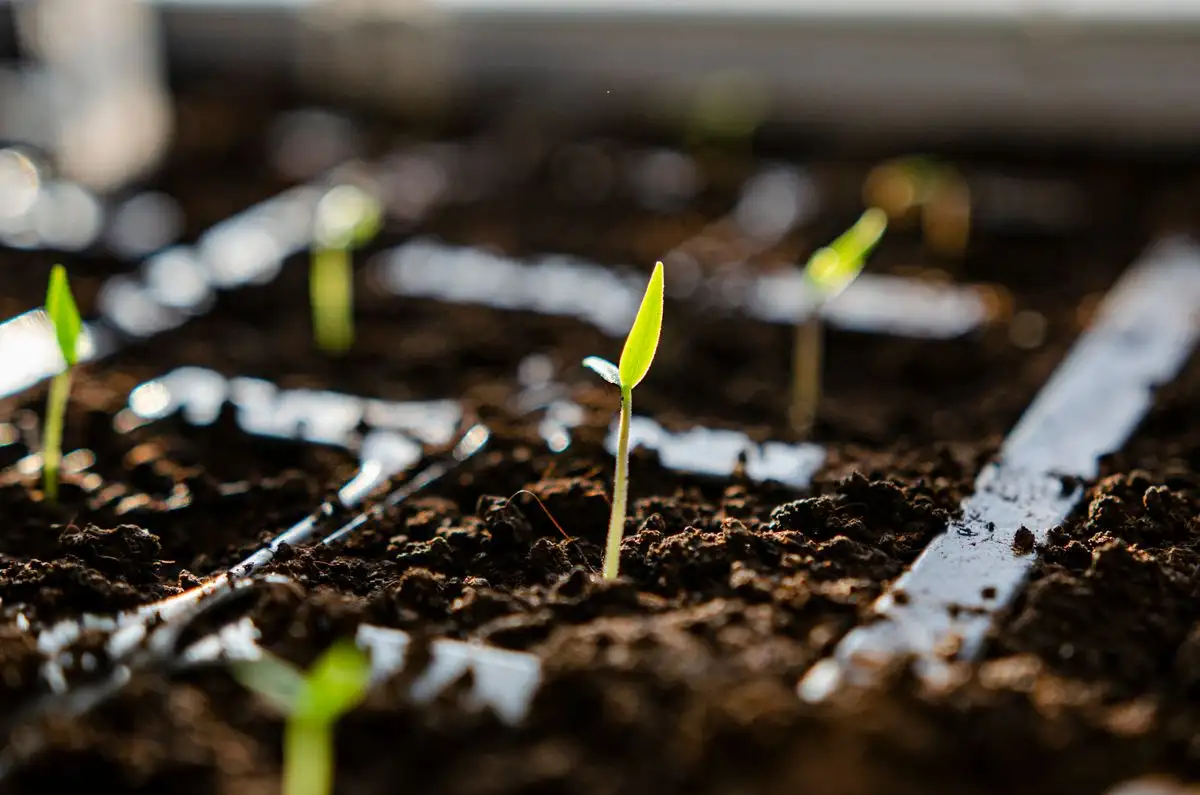
Most germination failure is a medium problem, not a seed problem. A seed already carries its own food reserve and its own genetic clock; the one thing it cannot carry is a supply of air, and a shallow tray of dug garden soil or last season's spent potting soil is precisely the medium that will not give it any. Soilless starting mix is built around air porosity — peat or coir for water holding, perlite and vermiculite for the pore space between particles — while garden soil compacts under watering, crusts at the surface, and can introduce damping-off fungi and dormant weed seed into a tray that was supposed to be clean. Change the medium before the seed gets blamed.
I keep two buckets at the end of my bench. One holds last year's potting soil, dumped out of the containers in October and sitting in the shed all winter. The other holds fresh soilless mix.
Reach into the first bucket. Squeeze. It goes into a lump like damp cornmeal and keeps the shape of your fingers. Drop it back and pour water over the surface — the water sits, glazes over, then runs off the side. That little slide show is the entire reason a flat comes up patchy.
Now reach into the second bucket. It's lighter than it looks, and it doesn't hold a ball the same way. Squeeze and it clumps, sure, but roll it between your palms and it falls apart into crumbs with visible white flecks in them. Water hits it and disappears in a second. That's the difference you're buying.
What the seed is actually waiting for
A germinating seed is a tiny combustion engine. It's burning through the food it packed for itself, and burning means it needs oxygen — the whole time, from the moment it takes on water until the first true leaf is up and running.
That's the part most people skip. We talk about moisture and warmth and light, and we treat the medium as a passive container. It isn't. It's a gas exchange system. The medium's job is to hold enough water against the seed coat that imbibition can happen, while leaving enough connected pore space that oxygen keeps reaching the seed and carbon dioxide keeps leaving. Get that balance wrong in the wet direction and you've built a small oxygen-free chamber — and seed in an oxygen-free chamber doesn't just fail to sprout. It rots.
Peat and coir give you the water-holding half. Perlite and vermiculite give you the pore space, and part of why those little white flecks look out of place in a natural soil is that they are — they're manufactured to do a job soil does not do on its own. Scoop a handful of soilless mix and you're holding a lot of air. Scoop a handful of garden soil and most of that space is filled with fine particles and water.
Why garden soil fails in a flat
Garden soil in a seed flat has three problems stacked on top of each other, and they all get worse with every watering.
The first is compaction. A flat is shallow — an inch and a half to three inches of medium, usually — and you're watering it from above twice a day. Clay and silt fines migrate downward with that water and settle into the pore spaces, sealing them. By week two you have something that started as loam and is now behaving like a shallow pan of brick.
The second is surface crusting. When the top fraction of an inch dries, the fines bind together into a skin. Tilt a flat like that toward a window and rap it with a knuckle and it sounds like a drum. Water beads on it and rolls toward the edges. And when a seedling does try to push up under it, a lettuce or a basil has to lift that crust with a stem the thickness of a hair. Some of them can't. You'll find them bent double under the surface, hooked over like a fish.
The third is what you brought in with it. Garden soil is a living community, which is usually the thing we love about it, and in a seed flat it works against you. Damping-off organisms — the ones that turn a stem to a water-soaked pinch at the soil line and drop the seedling overnight — live in that community and need exactly the conditions a flat provides: a wet surface, no air movement, crowded seedlings, warm temperatures. Then there's the weed seed bank. Every spoonful of garden soil carries seed that has been waiting, sometimes for years, for someone to disturb it and keep it wet. Weed seed doesn't get the memo that this flat was for peppers.
What's still sitting in last year's potting soil
Reused potting soil is a milder version of the same story, with two additions.
The first is structure loss. Perlite migrates upward over a season of watering and ends up at the top of the container, or it gets crushed and powderized. Peat and coir don't stay peat and coir forever — they break down into finer and finer particles under wet-dry cycling. A mix that started fluffy is, a year later, a denser, less aerated material that settles hard in a cell. It still looks like potting soil. It doesn't behave like it.
The second is what accumulates. Soluble fertilizer salts from a season of feeding concentrate at the surface as water evaporates, sometimes showing up as a pale crust on the rim of an old pot. High salt around a seed creates an osmotic pull that works against the seed taking on water at all. The medium can look damp enough to satisfy you and still be one a seed can't drink from. Along with the salts come the residues of last season's roots and whatever pathogens built up in a container that was never cleaned between crops.
None of that makes the old stuff trash. It means it isn't a seed-starting medium anymore. I blend it roughly half and half with fresh mix for anything going into a large container, and I use it straight as backfill around a transplant that's already up and hardened off, where nothing has to emerge through a surface. I don't run it under a tray of seed at full strength. When I've been tempted, I've split a flat — half the cells on the old mix, half on fresh — and the difference was obvious enough that I stopped running the experiment.
The step most people skip
Almost nobody pre-moistens.
Dry soilless mix straight out of the bag is a bad host. Peat in particular is hydrophobic when it's bone dry — water runs down a channel next to it rather than into it. Fill your cells dry, sow, then water from the top, and you get channels, dry pockets, and cells that are soaked at the top inch and bone dry two inches down where the seed actually is.
So do it in a bowl first. Add mix, add water, work it with your hand until there are no dry pockets, then grab a handful and squeeze. You want a few drops coming out between your fingers — not a stream, not nothing. Wrung-out sponge. If it streams, you overdid it and you've closed up the air space you were trying to preserve. If nothing comes out, add a little more and work it in again.
Then fill the cells loosely, tap the flat down on the bench a couple of times to settle it, and level the surface with your hand or a straightedge. Don't press. Pressing is how you turn a fluffy mix back into the thing you were trying to avoid. The one place you can firm the medium is right around the seed you just placed, if it needs contact.
Depth, and the seeds that need to see daylight
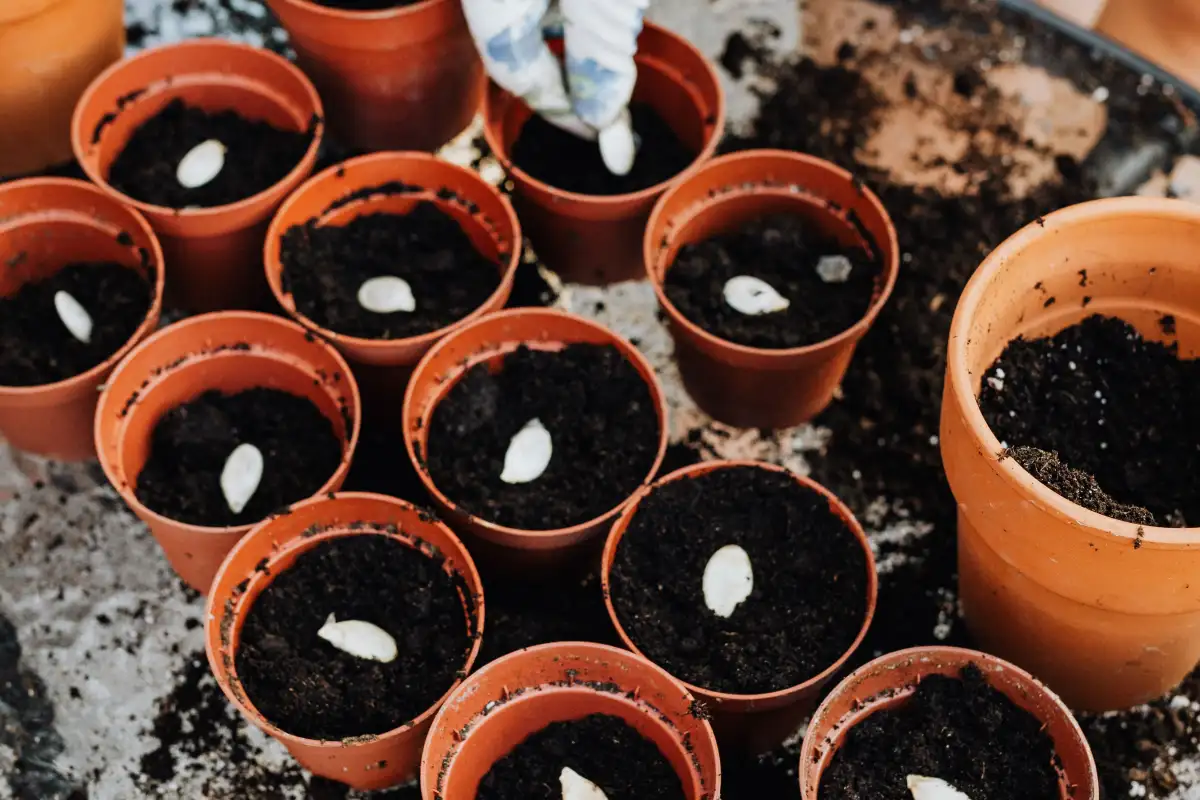
Depth is where the medium and the seed finally meet, and the rule is short: sow at two to three times the seed's diameter. A tomato seed goes about a quarter inch down. A bean goes an inch.
But the rule has a category that breaks it. Lettuce, celery, and a handful of others need light to germinate, which means the seed wants to be pressed onto the surface and barely covered, or not covered at all — just firmed in so it has full contact with damp medium. Bury a lettuce seed at a quarter inch and you've cut its germination without ever knowing why.
And after sowing, stop watering from above with anything that lands with force. A hard stream moves seed, drives small seed deeper than you set it, and puddles the surface. Mist it, or set the flat in a tray of water and let it wick up from below until the surface darkens. Bottom watering also keeps the surface drier, which matters if you're trying to keep damping-off from getting a foothold.
When it's actually the seed
I'm not saying seed never fails. Old seed stored in a hot garage loses vigor, and a packet that sat in a car over a summer is worth testing on a paper towel before it takes up tray space.
But the tray usually tells you which one you're dealing with. If the failure is patchy in a way that tracks with the flat — a crusted block of cells along the front edge where the fan hits, a row that stayed wet because it's under the drip line — that's the medium. If the ungerminated seeds are still plump and firm in the cell, sitting in medium that has gone slick and sealed, that's the medium too. Seeds that never got a chance look exactly like that.
The seed was probably fine. The cup it was sitting in wasn't.