Organic amendments release almost nothing on the day they go into the soil. Nitrogen, phosphorus, and potassium stay locked in organic form until soil microbes mineralize them, and that process runs on soil temperature and moisture rather than on the calendar or on how much you applied. In soil below roughly 50 degrees Fahrenheit, mineralization effectively stalls. The working rule is to apply an amendment two to four weeks before the crop actually needs that nutrient, and to choose an amendment whose release speed matches how fast the demand arrives.

I learned the timing side of this with a thermometer, not a book. There's a metal probe in my kitchen drawer next to the instant-read, and it lives there because I got tired of being confidently wrong every March.
Late March, second-floor balcony facing south, three ten-gallon fabric pots lined up against the railing. The concrete is cold through my knees. I push the probe four inches into the mix I filled the night before and it reads 46. By three in the afternoon, sun full on the black fabric walls, it reads 55. By seven the next morning it's back to 47.
That was the year I planted spinach and worked in blood meal the same afternoon, cup of it scratched into the top two inches, because that's what the bag said and because spinach is a leafy crop and leafy crops want nitrogen. The spinach came up. Then it sat there, pale and small, for three weeks. So I added more blood meal. It did nothing, which should have been the clue. The problem was never the amount. The problem was that I was pouring a schedule into soil that couldn't run it yet.
The clock is soil temperature, not the date
The microbes that do this work are dormant in cold soil. Fifty degrees is the working threshold most growers use, and it isn't a switch that flips at 50.0. It's a curve. At 46 you get almost no mineralization. At 55 you get some. At 70 with steady moisture you get a lot, fast. That's why the same scoop of blood meal can green up a tomato in ten days in June and do nothing for spinach in March.
Containers make this trickier than ground beds, in both directions. A dark ten-gallon fabric pot sitting on sun-warmed concrete heats up faster in spring than the soil in a garden bed, which sounds like an advantage and partly is. But the volume is small, so it swings hard. A pot that hits 58 at four in the afternoon can be 46 at dawn. What matters for mineralization is hours above the threshold, not the peak reading on a sunny afternoon. If you check once, check in the morning before the sun hits.
Moisture is the other half of the clock, and dry-down is the failure mode I underrate most. Mineralization needs a moist, aerated mix. A container that dries out between waterings stalls the process even in July, and in a small pot that can happen in a single hot afternoon. It's the same reason an amendment can sit in a bone-dry bag for two years and never break down.
Matching amendment speed to crop demand
The useful question isn't which organic fertilizer is best. It's how many days until this crop needs this nutrient, and how many days until this amendment can deliver it.
Fish emulsion is the fastest thing in the organic toolbox. It's soluble, it's available within days, and it's dilute, which is why it needs reapplying every two to four weeks. I treat it as a bridge, not a plan.
Blood meal runs around 12 percent nitrogen and is fast by organic standards, but fast still means a week or two of warm, moist soil, not overnight.
Bone meal is the opposite end. It's slow, and its phosphorus comes loose mostly in acidic soil. If your mix sits near neutral or you've limed it, expect very little from bone meal in the same season you applied it. That's not a defect; it's a reason to put it in early or not count on it at all.
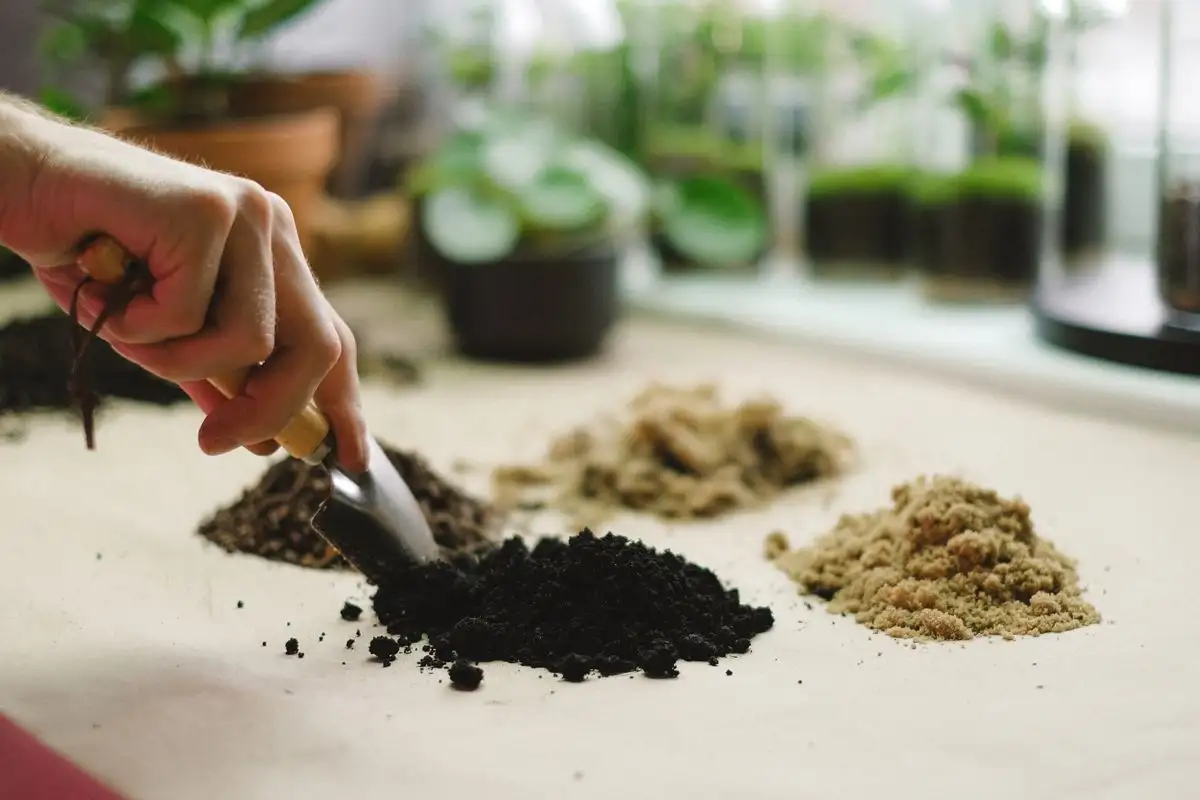
Compost is usually low and balanced across nitrogen, phosphorus, and potassium. That's the point. It's a soil amendment — structure, water holding, microbial habitat — not a stand-alone nutrient source. When someone says their compost "didn't do anything" in spring, they were often expecting fertilizer behavior from an amendment.
Manure-based compost has its own skew. It tends to carry phosphorus and salts well past what vegetables use, while nitrogen remains the nutrient actually limiting growth. In a ground bed that surplus has somewhere to go. In a container with one drainage hole, it accumulates season after season. Which means the fix for a struggling container plant is often not more manure compost. That just deepens the imbalance.
The planting-day mistake
Working amendments in at planting is completely reasonable — if the crop will need them in three or four weeks. It's a bad trade when you direct-sow a cool-season crop into 46-degree mix and expect it to green up in ten days. Early spring in a container is the hardest case, because the soil may sit below threshold for a month.
For warm-season crops the math gets friendlier. Tomatoes and peppers go out in late May or June into mix that's already in the sixties and climbing. Two weeks to availability is realistic. Bone meal worked in at transplant is roughly on schedule for phosphorus demand at first flower set — which is what "matching" actually looks like in practice.
Cool-season crops need a different order of operations. Either start with mix that already carries finished compost and an active microbial population, or accept that the plant's early demand will be met by something soluble while the slow amendments catch up.
What I do now
Check the temperature first, before deciding anything. Below 50, I don't expect organic nitrogen to move, and I don't confuse a stall with a shortage.
Slow amendments go in early, into mix that's already warm, or the previous fall into a bed. Fast soluble nitrogen is held back for the gap — the two-to-four-week window when the plant is visibly asking and the slow material hasn't answered. Reapplied every two to four weeks while that window is open.
Compost goes in for structure, and I stop loading manure-based compost into containers once phosphorus and salts are clearly banked, because nitrogen is what I'm actually chasing.
And I count weeks from the day the soil crosses the threshold, not from planting day. A cold spring doesn't delay the schedule by a few days. It delays the start of the clock entirely, and everything downstream moves with it.
The threshold itself is a working number, not a law. Pot color, sun exposure, mix composition, and how often you water all shift where your soil sits. The one thing that doesn't shift is the sequence: microbes first, nutrients second, roots last. Get the order right and most of the guesswork goes away.