Plant peas, beans, or a light-feeding root crop after lettuce. Plant brassicas, chard, or another nitrogen-hungry leafy crop after peas. Both answers come from the same two questions asked at the same moment — which plant family just vacated that spot, and what did that crop leave behind in the soil — and neither of those questions is "what grows well next to what."
I make this call with a bucket in one hand
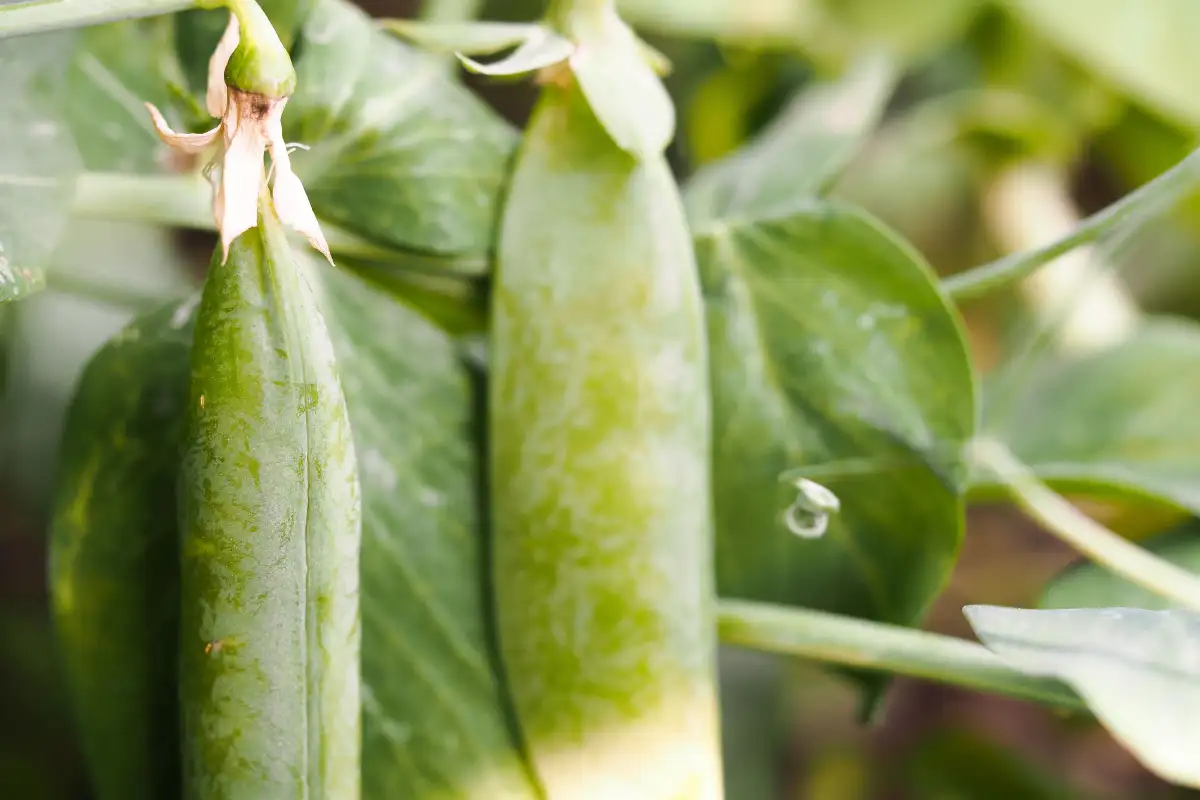
The bed in front of me is four feet by eight and it has just given up its last pea. I'm straddling the trellis line, pulling vines off the twine in handfuls — dry and papery at the bottom where the pods filled, still snapping green at the top where they never did. There's a bucket beside me that I keep filling and it keeps not being full enough.
When I tip the vines out, I get to see what the peas actually left. A pale mat of roots, and on them the small pink nodules where the rhizobia were working. That's the whole reason a legume earns a spot in a small garden: the plant paid for its own nitrogen and had some to spare.
Except the nitrogen isn't in the soil. It's in the plant. If I carry that bucket to the compost pile, I've walked most of the credit out of the bed. Peas do their best work for the next crop when the vines get chopped and dropped right there, or turned under shallow, and the worms do the rest. Hauling the residue away is the most common way people accidentally turn a legume crop into a neutral one.
So what's actually sitting in that bed when I'm done is a modest nitrogen credit, soil loosened by pea roots, and a legume footprint. That combination is close to custom-made for brassicas.
The two questions, in order
First question: which family was here? Second question: what did that family leave behind — a nitrogen credit, a nutrient deficit, or a pathogen population that has been quietly multiplying in that spot since the last time I planted it?
Ask them in that order and the choice mostly makes itself. Ask only the second one and you'll keep planting tomatoes in the same corner because the corner is sunny. Ask only the first one and you'll rotate beautifully while slowly starving the bed.
Six families cover almost everything I grow
Legumes (Fabaceae) — peas, bush and pole beans, fava beans. Nitrogen fixers. Never follow a legume with another legume; you waste the credit and stack the same root-rot organisms.
Brassicas (Brassicaceae) — kale, cabbage, broccoli, cauliflower, Brussels sprouts, bok choy, arugula, radish, turnip. Heavy feeders, and the family with the most persistent soil-disease problem. Clubroot can stay viable in ground for years, which is why extension guidance pushes brassicas onto a long return interval.
Nightshades (Solanaceae) — tomato, pepper, eggplant, potato. Heavy feeders. They share soil-borne wilt organisms and foliage blights, so stacking them is the classic small-garden mistake.
Alliums (Amaryllidaceae) — onion, garlic, leek, shallot, chives. Light feeders and slow growers. White rot is the reason extension material keeps alliums out of the same ground for many seasons; the sclerotia persist a long time.
Carrot family (Apiaceae) — carrot, parsnip, parsley, celery, dill, fennel, cilantro. Light feeders with deep roots that want loose, not rich, soil.
Lettuce and its relatives (Asteraceae) — lettuce, endive, radicchio, chicory. Light, shallow, fast. Also worth tracking: beets, spinach and chard (Amaranthaceae, light to moderate) and cucumbers, squash and melons (Cucurbitaceae, heavy).
The reason family matters more than the individual crop name is that family is what predicts carryover. Two crops in the same family are the same host for the same soil organisms. "Kale after cabbage" is not a rotation. It's a repeat.
The nutrient ladder underneath the family rule
Family answers the pest question. Nutrient demand answers the fertility question, and in a small bed it's the one that bites faster.
Heavy feeders — tomatoes, squash, corn, brassicas, cucumbers — want a bed that was fed. Light feeders — carrots, onions, herbs, beets, lettuce — want a bed that has already been fed and is settling down. Fixers — peas and beans — make their own.
The practical sequence is fixer, then heavy feeder, then light feeder. Peas or beans build the credit; a brassica or a tomato spends it; a carrot or an onion cleans up what's left without demanding more. Put the light feeder first and you've wasted the best bed of the year on a crop that didn't need it. Put two heavy feeders back to back and the second one tells you about it in July, when the leaves go pale and nothing you pour on seems to catch up.
And don't put carrots right after peas just because the soil is loose. Excess nitrogen after a legume gives you forked, hairy, overgrown roots. Carrots want the spot a heavy feeder just vacated.
Greens after legumes, and why that one is nearly foolproof
There's a reason direct-seeded leafy greens are the follow-up I trust most after peas. The timing works: peas finish and come out early enough that there's a real season left. The seed goes in dry, germinates in days, and doesn't need transplanting or hardening off. The roots are shallow, so they use the nitrogen sitting near the surface instead of chasing it downward. And greens finish fast enough to be out before the first hard freeze.
Late summer is also when lettuce, spinach and brassica seedlings stop bolting and start behaving. Direct-seeding in that window is easier than nursing transplants through July heat.
Follow-ups that go wrong quietly
- Tomato, pepper, eggplant or potato after any of the others in that family. Same wilts, same blights, same exhausted bed.
- Cabbage, broccoli or Brussels sprouts after kale. Clubroot and root maggot pressure accumulate in exactly the spot you just used.
- Onion or garlic after the other. White rot doesn't care which allium you meant.
- Beans after peas. Both legumes, both the same root issues, and you've spent the nitrogen credit on nothing.
- Lettuce after lettuce, or after endive and radicchio. Same family, same shallow feeding zone, and lettuce drop organisms don't leave just because you switched varieties.
- A second heavy feeder after a heavy feeder, with no amendment and no legume in between.
The calendar is the rotation in a small plot
Here's the thing nobody tells you when they hand you a four-year rotation chart: I can't out-distance a soil organism in a ten-by-twelve-foot yard. Bed one and bed four are three feet apart. Distance rotation is a farm tool. In a city garden, the axis I actually rotate on is time.
That's why a cool-warm-cool sequence does the heavy lifting. Spring cool crops — peas, spinach, lettuce, radish, arugula. Summer warm crops — beans, cucumbers, peppers, squash, basil. Fall cool crops again — kale, chard, carrots, spinach, then overwintering garlic.
One illustrative chain across three years in the same bed, purely to show the shape of it:
- Year one: spring peas, summer cucumbers, fall kale and radishes.
- Year two: spring lettuce, summer tomato, fall spinach.
- Year three: spring carrots, summer bush beans, fall-planted garlic for next summer.
Nightshades didn't repeat. Brassicas didn't repeat until year four. Legumes got a two-year gap. Heavy feeders were always preceded by a fixer or an amendment. That's the whole trick, and it doesn't require a spreadsheet.
Containers are a different decision entirely
In a raised bed, the rotation is about the ground. In a five-gallon pot, the rotation is about the mix, and the mix doesn't rotate. A pathogen that got into a pot is still in that pot next season, no matter how many times you circle it around the balcony. What resets a container is replacing the growing medium, not relocating the container.
That said, I don't dump every pot every year. So the rule I use is: no family goes back into the same pot two seasons running, and nightshade pots get fresh mix or get retired to something unrelated. If a tomato had a rough year in a pot, that mix is done for tomatoes and probably for peppers.
Grouping by family is what makes this legible. If my pots are jumbled — one tomato, one pepper, a kale squeezed between them — I genuinely cannot remember what touched that spot two summers ago. When the nightshades sit together, the alliums sit together and the greens sit together, the next move is obvious at a glance. Grouping isn't aesthetic. It's bookkeeping.
Where this breaks, honestly
In a tiny garden, a true three-to-four-year family rotation is often impossible. You have one sunny wall and you want tomatoes on it. That's fine — you just have to be honest about the tradeoff and compensate somewhere else: refresh the medium, keep the residue in the bed, and never let the same family own the same spot in back-to-back seasons.
Rotation is also not a substitute for basic sanitation. Diseased foliage and fallen fruit belong in the trash, not the compost and not on the soil surface. Rotating families around a pile of last year's infected leaves accomplishes very little.
And one more limit worth saying out loud: rotation reduces pressure, it doesn't eliminate it. In a small plot with a long history of one family, you're managing a problem, not erasing it. The bucket of pea vines in my hand is still the best tool I have for the next bed, but it's not the only one.