The moment a leafy green or a root crop is edible, it becomes a harvest candidate. Peak size is a bonus, not a requirement. In a small plot, pulling at that first good-enough stage is what frees the six to eight weeks the next succession needs before the season shuts down, which makes most harvest decisions scheduling decisions wearing a quality costume.
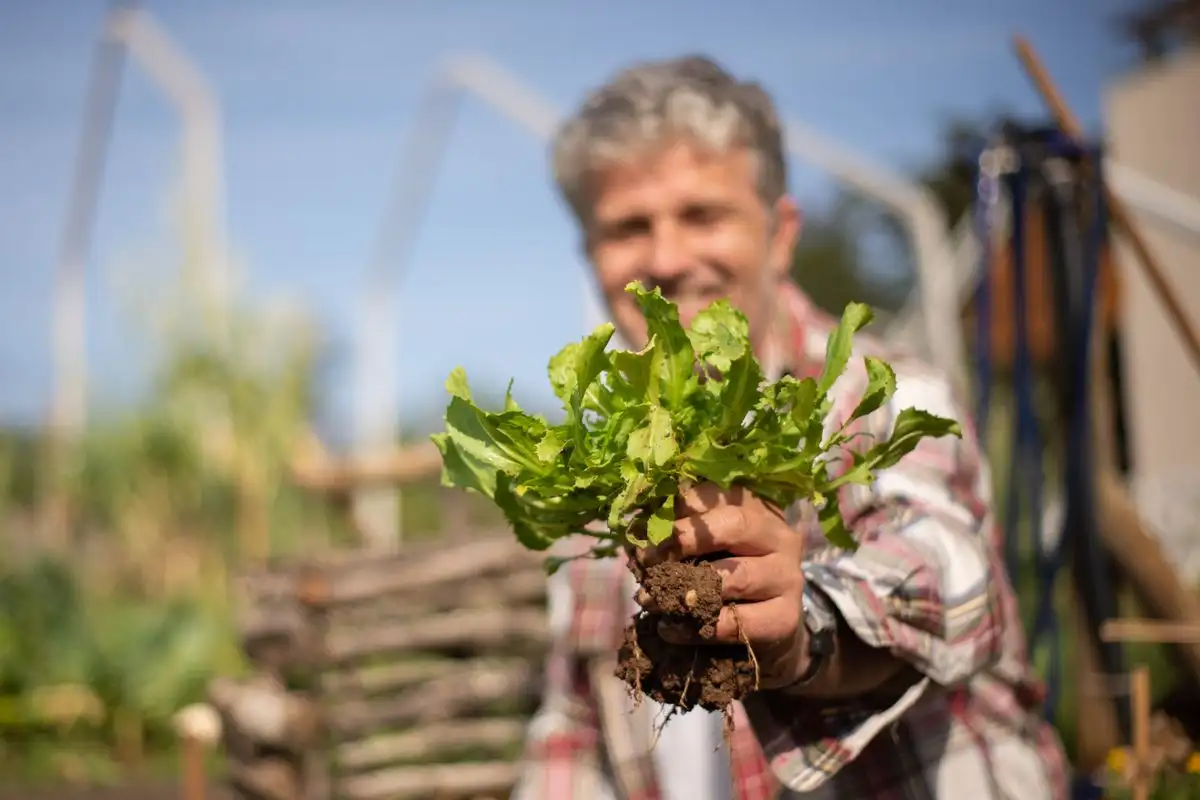
It's the third week of August, a little after seven, and I'm crouched over a four-foot bed of arugula with my coffee going cold on the fence post. Six beds in a backyard that is not really big enough for six beds. Every one of them is spoken for between now and the first hard freeze, so every bed I stand in front of is a bed I am taking away from something else.
Look at the arugula with me. Most of the leaves are still flat and low, palm-sized, a deep cool green. But four or five in the middle have lifted, narrower and more upright, with edges going lobed where they used to be rounded. Nothing has flowered. The stems are still soft enough to pinch. Give it five more days and that center will stretch, the leaves will shrink and stiffen, and the bed will stop being worth the square footage it is sitting on.
The radishes next door are easier, because they tell you from below. I run a thumb along the soil line at the base of one: a quarter inch of purple shoulder is up out of the dirt, the skin smooth and unbroken. The packet says 28 days. I sowed 24 days ago, but we have had a week of ninety-degree afternoons, and heat moves a radish faster than a calendar does. That root is ready now. Ten more days and it will be spongy, and the next hard rain will split it open.
This is the part where most of us stand there and wait anyway, because the packet said 28 and it is only day 24, and perfect is a habit.
The packet date is a guess with good manners
Days to maturity is an average of a plant grown in average weather by an average gardener. It usually does not tell you whether it is counted from sowing or from transplant, and that single omission is worth a week or two of error depending on the crop.
More to the point, it does not know your August. Heat pushes greens toward bolting and pushes roots to size up fast and then go pithy. Cool weather does the opposite, and shortening day length in late summer slows everything down on top of that. A 45-day spinach sown in early September in my yard behaves more like a 60-day spinach. As a working adjustment, I add roughly two weeks to the packet number for anything sown after midsummer and treat that as the real number for planning. It is a rule of thumb and not a law, and it is wrong in both directions sometimes, but it is wrong in a way I can see coming, which beats trusting a number that has no idea what month it is.
Read the plant instead of the packet
Greens lift before they bolt
The cue you want arrives about a week before the flower stalk does. In lettuce and arugula the center of the rosette rises and narrows. In spinach the whole plant cups upward instead of lying flat against the soil. Kale and chard bolt slowly, so the tell is different: new leaves come out smaller and closer together while the stem gets tall and bare at the bottom. Once the stalk is up and the leaves have gone narrow and stiff, you have missed it. The plant has stopped being food and started being a seed factory.
If you catch that lift early, you can cut the whole bed, get a full harvest, and still have the soil turned over by the weekend.
Roots announce themselves at the soil line
You almost never have to dig to check a root crop. Radishes push a shoulder above the soil line, and the width of that shoulder is roughly the width of the root underneath. Half an inch of shoulder is a radish you can eat. Split skin means it is already past. Beets do the same thing around an inch and a half to two inches of crown, and their leaf stems start stretching and going floppy at the same time. Carrots are trickier because they barely shoulder, but the crown at the soil line gives you the diameter: a crown about the width of a quarter is a usable carrot. In loose soil with steady moisture, leaving it longer gets you a bigger one. Leave it longer in heavy clay and you get forked, woody roots instead. Carrots also hold in the ground through light frost, which matters, because it makes them one of the few crops you can leave sitting while you decide about everything else.
Cut-and-come-again is a schedule, not a reprieve
Lettuce, arugula, mustard, kale, chard: cut them two inches above the crown or strip the outer leaves and they come back. That is the reason people leave them in the ground for months. But what comes back is smaller every time. In May a single lettuce plant gives you a bowl a week for a month. In September, under shrinking light, the same plant gives you a bowl, then a handful, then a garnish. That decline is the number that matters, not the fact that the plant is still alive.
A crop that would keep producing forever in May is a liability in September, because the thing you would replace it with has a deadline and the thing in the ground does not.
Count backward from the freeze
Two things to look up: the first expected frost date for your area, and the days to maturity of whatever you want to plant next. Get the frost date from your extension office or your local weather normals rather than a phone app. A ten-day difference changes the answer, and the app is often quoting a station at the airport twenty miles away.
Then do the arithmetic. Days to maturity of the next crop, plus about two weeks for the fall slowdown, plus a week of slack in case germination is poor. Subtract that total from the frost date. What is left is your last viable sowing date for that bed.
If today is past it, the bed is either the current crop or bare ground until spring. That is the whole decision, and it is binary in a way that makes it easy once you have written the date down. If today is before it, you have a choice, and the choice costs you something either way.
Two wrinkles worth knowing. Frost-hardy crops such as spinach, kale, carrots, and turnips push the last sowing date later than tender crops do, so the deadline is per-crop and not per-season. And germinating in August heat is its own problem: lettuce seed sulks in soil much above 80 F, so the succession may need to start in a pot in the shade and go in later, or be sown into the shadow of the crop you are about to pull. Sowing the next thing into the gaps a few days before you terminate the current one is a legitimate move and it buys you a week.
The rule I use when I am standing there with the trowel
Two numbers, both of them estimates, both of them good enough.
One: how many more days of harvest I would actually want does this crop have left in it? Not how many days it will stay alive. How many days it will keep giving me something worth picking.
Two: how many days until the next crop's planting window closes for the year?
If the first number is smaller than the second, pull the crop and replant today. If the first number is bigger, keep harvesting, and write the flip date on the calendar, because those two numbers are moving toward each other and the flip is coming whether you plan for it or not.
There is a third option that gets left out of most advice, which is the middle path. Pull every other radish and let the rest size up. Thin the beets and keep the thinnings. Cut the arugula hard, top-dress with an inch of compost, and sow the next crop into the gaps the same afternoon. You do not always have to choose between the crop in the ground and the crop you want; sometimes you split the bed and take half of each. But you do have to decide which of the three you are doing today, because the one thing you cannot do is stand there waiting for perfect and get nothing planted.
By the time I stand up, the coffee is cold and the arugula is in a colander. The radish bed gets pulled, composted, raked. Spinach goes in before lunch. The light at seven in the morning is already at a different angle than it was in June, and I can see exactly how many of those mornings I have left.